Create Your Own Automated Satirical Newspaper with AI, No Design or Writing Skills Needed
Editorial line, legal framework, automated news monitoring, articles, cartoons and layout: launch a newspaper that makes people smile.
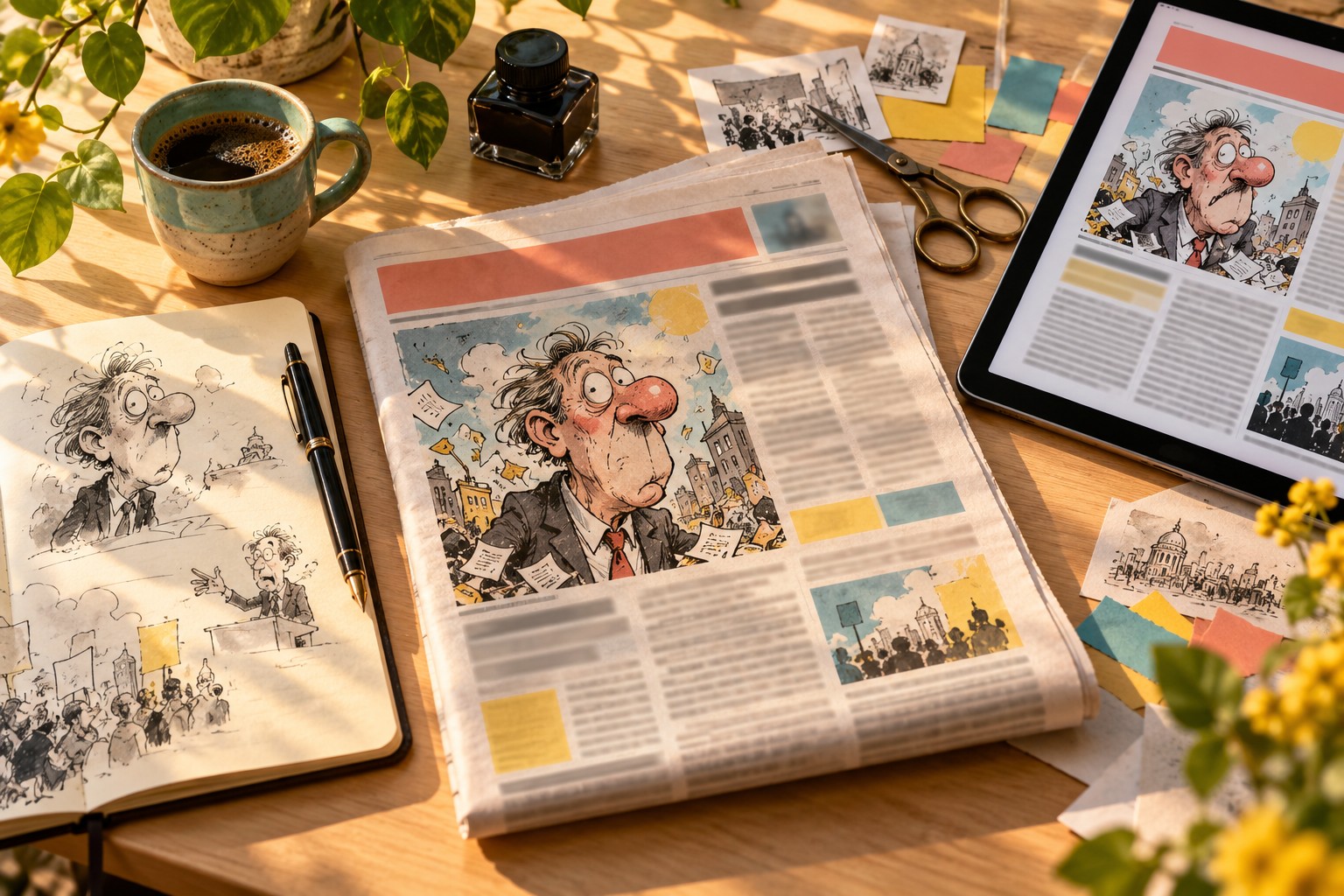
What you will learn
Create a regular, legally sound satirical newspaper: AI prepares the news monitoring, drafts and layout, while you keep the wit and the final say.
-
Editorial lineDefine your tone, your sections and your limits
-
Legal frameworkSatire, diffamation (defamation), image rights and mandatory notices
-
Automated news monitoringReceive the stories that matter every day
-
Assisted writingFunny articles with AI, but in your own voice
-
Press cartoonsIllustrate with AI while knowing its limits
-
LayoutA reusable newspaper template in Canva or Affinity
-
n8n / Make pipelineConnect monitoring, writing and layout with human approval
-
Distribution and incomePDF, website, newsletter, social media, subscriptions and donations
A step-by-step learning path
11 modules and 60 lessons to progress step by step.
1Getting your satirical newspaper off to a good start5 lessons
- 1.1 Welcome: the newspaper you are going to build
- 1.2 Satire past and present
- 1.3 What AI automates, and what remains your job
- 1.4 Tools, budget and organisation
- 1.5 Newspaper project sheet
2Editorial line and the codes of satire6 lessons
- 2.1 Defining your editorial line
- 2.2 The mechanisms of satirical humour
- 2.3 The formats of a satirical newspaper
- 2.4 Headlines and endings: the art of the punchline
- 2.5 Clearly signalling satire to the reader
- 2.6 Editorial charter
3The legal framework in France7 lessons
- 3.1 Freedom of expression and the right to humour
- 3.2 Diffamation and injure (defamation and insult): where are the limits?
- 3.3 Public figures and private individuals
- 3.4 Image rights, privacy and caricature
- 3.5 Mandatory notices and the directeur de publication
- 3.6 Discrimination, provocation and prohibited content
- 3.7 Legal checklist before publication
4Automating news monitoring4 lessons
- 4.1 Choosing your news sources
- 4.2 RSS feeds and feed readers
- 4.3 Google Alerts, newsletters and filters
- 4.4 Summarising and sorting your monitoring with AI
5Writing humorous articles with AI and your own voice7 lessons
- 5.1 Defining your author's voice
- 5.2 The satirical writer prompt
- 5.3 Finding the angle: brainstorming ideas with AI
- 5.4 From first draft to final article
- 5.5 Avoiding the pitfalls: clichés, false information and flat humour
- 5.6 Producing a complete issue in half a day
- 5.7 Style guide and prompt library
6Caricatures and press cartoons with AI5 lessons
- 6.1 The codes of the press cartoon
- 6.2 Defining the newspaper's graphic style
- 6.3 Generating satirical cartoons with image tools
- 6.4 Real people: what the tools refuse and what the law allows
- 6.5 Adding speech bubbles, captions and finishing touches
7Laying out your newspaper6 lessons
- 7.1 Anatomy of a newspaper page
- 7.2 Creating your visual identity
- 7.3 A complete template in Canva
- 7.4 Template in Affinity Publisher or InDesign
- 7.5 Variations: website, newsletter and social media
- 7.6 Templates provided
8Building the automated production pipeline7 lessons
- 8.1 Overview of the pipeline
- 8.2 Getting started with n8n and Make
- 8.3 Automating the collection and sorting of news
- 8.4 Generating article drafts automatically
- 8.5 Filling the template automatically
- 8.6 Making it reliable, monitoring it and keeping costs under control
- 8.7 Annotated scenario diagrams
9Editorial approval before publication4 lessons
- 9.1 The approval process
- 9.2 Checking facts, targets and wording
- 9.3 Corrections, right of reply and handling complaints
- 9.4 Editorial approval grid
10Distributing your newspaper4 lessons
- 10.1 The issue PDF and the archive
- 10.2 Publishing on a website
- 10.3 The newspaper's newsletter
- 10.4 Social media: formats and platform rules
11Monetising your newspaper and making it last5 lessons
- 11.1 Possible business models
- 11.2 Subscriptions and donations in practice
- 11.3 Print edition: print on demand and local sales
- 11.4 Keeping up the pace without burning out
- 11.5 Launch plan and editorial calendar
Full course overview
You have an eye for spotting the absurd in the news and the urge to share it, but writing every week, drawing, laying out and distributing a newspaper feels out of reach? And you wonder how far satire is allowed to go? This course guides you through creating your satirical newspaper, step by step.
The promise
This course teaches you to create a regular, polished and legally sound satirical newspaper, handing the repetitive tasks to AI: news monitoring, first drafts, illustrations and layout. The angle, the final humour and the decision to publish remain yours.
The method
- Editorial line and the codes of satire: tone, sections, how humour works.
- The French legal framework: freedom of expression, diffamation (defamation), image rights, public and private figures, mandatory notices, the role of the directeur de publication (the legally responsible publisher).
- Automated news monitoring with RSS feeds, alerts and AI summaries.
- Assisted writing of funny articles that keep your voice.
- Press cartoons with AI, knowing their limits.
- Layout of a real newspaper in Canva, Affinity or InDesign.
- Automated pipeline with n8n or Make, a language model and your template.
- Distribution and funding: PDF, website, newsletter, social media, subscriptions, donations and a print edition.
Who is it for?
News enthusiasts, associations, content creators and freelancers, with no technical skills required. Your trainer, Yvon-Patrick MAMIA, is a graphic designer, web developer, published author and trainer with more than 15 years' experience: he builds the course's running-example newspaper right in front of you.
What's included
52 videos across 11 modules, editorial charter and layout templates, prompts, annotated automation scenarios, legal and editorial checklists, quizzes and a certificate of completion.
Course in preparation: modules open progressively. Enrol now to benefit from the launch price and receive your access by e-mail as soon as it opens.
Your satirical newspaper: going further
To go further, Create professional videos with AI helps you share your satirical newspaper on social media. Then, Create your own cartoon with AI brings your characters to life. Finally, the French Press Freedom Act of 29 July 1881 sets the legal limits of satire.
Who is it for?
- News and humour lovers who dream of launching their own publication
- Associations, collectives and committees who want an offbeat newspaper for their area or community
- Content creators looking for a regular, original format
- Entrepreneurs and freelancers who want a humorous newsletter for their sector
- People curious about AI and automation who want a concrete, complete project
Prerequisites
- A computer (Windows or Mac) with a stable internet connection
- No writing, graphic design or programming skills are required
- An account with an AI assistant (ChatGPT or Claude); a paid plan makes the work easier
- A free Canva account; free n8n or Make accounts will be created during the course
- A taste for current affairs and a wish to make people smile, while respecting others
Practical information
Detailed programme (PDF)- Format
- Remote (e-learning), at your own pace
- Duration
- 22 hours of training
- Price
- €792 · payment in instalments available
- Access arrangements and timescales
- Online registration at any time. Access to the course opens as soon as payment is confirmed. On first access, a positioning questionnaire (situation, goals, starting level, adjustment needs) lets us tailor your support; a free preliminary call is still available on request.
- Teaching methods
- Distance learning (FOAD) on the platform, available 24/7: demonstration videos, downloadable resources, practical exercises based on real cases and a running project. Live virtual classes and replays. Trainer reachable by email or phone, with a reply within 48 working hours; optional one-to-one mentoring.
- Assessment methods
- Positioning questionnaire on entry, automatically marked quizzes (to be passed to complete the course), tracking of progress and learning time, satisfaction questionnaires at the end and later on. A certificate of completion is issued automatically at the end of the course, with the results achieved; a certificate of achievement and an attendance record can be downloaded.
- Accessibility
- This course is accessible to people with disabilities. Contact our disability officer before enrolling so that we can look at possible adjustments together (materials, pace, support). Learn more
- Contact
- A question before enrolling? Book a free call · contact@mypaschool.fr · 06 07 08 00 54
Information sheet updated on October 11, 2026. Our results indicators · Make a complaint